This is a guest post by Beeb from Supercoupongirl. If you are not familiar with catalinas, make sure your read her post Catalinas 101. If you enjoyed this post you may want to subscribe to her blog.
I wrote an article recently explaining what catalinas are and how they work. So now that you know what they are, how can you find these great deals?
Word Of Mouth: The Internet has made it possible for coupon users to share deals like never before. I often see catalina deals posted on websites like Hot Coupon World and Money Saving Mom.
Check Your Sales Circulars: When stores run their own special catalina promotions, they’ll advertise it in their sales flier. For example, when Safeway ran its
How to Find Catalina Deals
Fun and Frugal Thanksgiving Decorations
This is a guest post by Jennifer from The Life and Times of the Lady Riposter, a Self-Confessed Foodie. She’s a full-time MBA student living in
Let me get one thing straight
Save on Insurance by Paying in Full
This is a guest post by Kacie from Sensetosave. Kacie is a soon to be first mom who blogs about her frugal lifestyle. Read this fun post she wrote about the Fuglier and Fugliest ways to save money. If you enjoyed her post consider subscribing to her blog.
If you’ve shopped around for better insurance rates and have combined insurance policies for additional savings, take your savings a step further:
Pay your premiums in full and make monthly payments to yourself.
Depending on your insurance premium, this could be daunting at first. However, once you get to the point where you are paying in full, each month you can deposit 1/6 or 1/12 of your premium into a high-interest savings account. You’ll avoid installment fees and you’ll earn interest on your savings.
For example, my car insurance is $366 for six months.
Each month, I send $61 ($366 divided by six months) into a savings account within ING Direct where it earns 2.75 % APY.
At the end of six months, I’ll have an extra few dollars in my car insurance savings account thanks to interest.
My car insurance company charges $4 per month if I pay in monthly installments. Over the course of six months, that’s an extra $24.
In all, paying my car insurance in full saves me at least $27 per six months.
I take this approach with our renters and life insurance policies as well.
You’ll save even more money if you have higher premiums and/or higher installment fees. If your six-month premium is $1,000 and you bank $166.66 each month at 3 percent interest, you’ll earn $8.73 in interest over that span. While that’s not a huge sum, it’s still your money.
Why let your insurance company make even more money? Pay yourself and pocket the savings instead.
- Kacie at www.sensetosave.com
Toy Story
This is a guest post by Jennifer Duenes. Jennifer is a writer, wife to husband Michael, and mother to son Elijah in the San Francisco Bay Area. She blogs regularly on frugal but meaningful living at http://www.lifefromtheroof.com/. If you enjoyed this post consider subscribing to her blog.
As I pushed my son’s stroller through Target this morning, it was hard not to be drawn to the toy section. Toy coupon books beckoned me from the aisles. Christmas trees and every other holiday decoration were already set up, sparkling and infusing a sense of joy and lightheartedness into the store.
And yet, as a new mother entering the first Christmas where her child will actually be able to play with the toys instead of just chewing on them, thinking of what to buy my son can feel overwhelming at times. Relatives write us as well, asking what we need. After having lived overseas for five years in a much poorer country, it’s hard to ever say that we “need” anything more than the basics.
But I don’t want to be a Grinch either. I grew up with toys, and I want my son to have the fun times and educational opportunities that I had. I just don’t want a pile of things collecting dust in a corner because he ended up not being interested in them for too long.
I’m still new at this, but as we enter this coming season, I have several principles in mind to guide my purchases:
Longevity
There are two aspects to this principle. The first is, “How long will it last?” Is it a high quality toy that won’t break apart two days after he gets it? I purchased a toy set once from an unnamed discount store, and spent very little money, but now spend a lot of time gathering together the pieces and reassembling the toy for my son because it keeps on falling apart.
The second part of longevity is “How long will he be interested in it?” Will the toy grow with him, or will he move beyond the developmental level it’s designed for in three months? We are very limited on space where we live. We have no garage or attic or storage room to put unused toys, so they really have to earn a place in our home.
Flexibility
How many different ways could he use this toy? One thing I’ve enjoyed asking for is a line of stuffed Audobon birds that give the real-life bird call of that bird when you squeeze them. Right now he just likes to hand them to me to make them sing, but in the future, I hope to do things like hide different ones under something and make him guess the bird by it’s call.
Experiences
In The Ultimate Cheapskate’s Road Map to True Riches, author Jeff Yeager observed that in his experience, memories appreciated over time, while objects generally depreciated over time, which was why he chose to use his money more on traveling to different countries than on consuming goods. With our kids, we too can create more memories and less clutter by giving them experiences. This past year, I and several friends received a zoo membership from families to our local zoo. Not only does it get us outdoors, but it’s also a great experience for my son to see real-live giraffes and tigers on a regular basis!
Necessary
At times I’ve seen kids’ kits for sale that mimic an adult set of something, only the quality is so much more inferior and the options are limited as to what you can do with that set. Now, I’ll be the first one to say how much I loved my Easy Bake oven growing up, or my little sewing machine, but why not invest in a higher-quality set of items that you could build on over the years that they could even use into adulthood?
<
b>Engagement
One mark of a good toy is how well it engages my son, especially when I have dinner to prepare or dishes to finish! But I don’t want him to have only activities that he does alone. As he grows, I want to buy things for him that creates a more engaging relationship between the two of us. One excellent book I used as a homeschool teacher overseas was Drawing with Children by Mona Brookes, who teaches children as young as three or four years old to draw impressively. The drawing lessons were clear and easy to execute, and as I did the lessons with my students, I found myself becoming a better artist as well! A great accompaniment to a book like this would be a set of high-quality paper or markers.
Review
It’s so easy to feel compelled to buy a toy in the store because of how cute or fun it looks, but I’ve learned quickly that it pays to look up reviews on toys online first before buying. We had a gift card which we used to buy a bath-toy holder that looked like a giant frog, and even despite the warnings online by some parents that it wouldn’t stay on the wall, I purchased it anyway because it was so cute. Well, you can guess what happened. We eventually returned the toy holder because we didn’t want our son to have nightmares of a giant frog attacking him as he took a bath!
Homemade Laundry Detergent
This is a guest post by Erin from “I am Frugal.” She recently wrote about how her family saves money on snacks. Her advice is simple and practical. If you enjoyed this post you may want to subscribe to her blog.

For the past six months or so I have been making our own laundry soap. I was a little skeptical at first to make my own and wondered if it would really work on my kids dirty clothes. But because of the cost of making my own laundry soap, which is about $.01 a load, I finally gave in and decided to buy the supplies one day when I was in need of some laundry soap. I figured it cost me about the same amount to by the supplies as it would to buy me a thing of laundry soap so if it didn’ t turn out I wasn’t really out that much money. I was VERY surprised at how easy it was to make the soap as well as how it worked in getting my family’s clothes clean. I am now on my 3rd batch of laundry soap and have never had any problems with the soap. Each batch of laundry soap makes about 2 gallons of laundry soap or more than 70 loads of laundry.
To get started you will need:
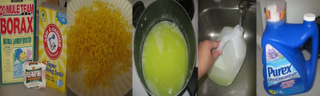
20 Mule Team Borax -about $4
Arm and Hammer Super Washing Soda- about $3
Fels-Naptha Soap bar- about $1
Total, all of this cost about $8, but the Borax and Soda you are only going to be using 1/2 a cup so this will last you for a LONG TIME. For the Fels-Naptha bar you will only be using 1/3 of the bar for each batch of laundry soap that you make so you will only have to buy one of these bars every once in a while and it is your cheapest cost. One thing to note about these ingredients is that I was NOT able to find any of these ingredients at Walmart. All of these ingredients can be bought at smaller stores like Albertsons, Smiths, and Maceys in the laundry section of the store.
To get started bring 6 cups of water to a boil. While your water is coming to a boil Grate 1/3 of your Fels-Naptha bar with a cheese grater. It will look like this:
When your water has come to a boil add your grated soap bar and mix until it is dissolved. When it is dissolved add 1/2 cup of Borax and 1/2 a cup of Soda to the mixture and stir again until it is all dissolved. It will look like this when it is all dissolved:
Now take 1/2 of the mixture, about 3 1/2 cups, and pour it into an empty milk jug. Now add water to the milk jug until it reaches the top and put on the lid. Shake the jug for a couple of minutes to mix it all together.
At this point you can either leave your first half of the laundry mix in the milk jug or you can do what I do and pour it into an empty liquid laundry detergent bottle like this one:
If you pour it into the liquid laundry detergent bottle then you will want to pour the rest of the mixture that is still in your pot into the milk jug again and repeat the process of adding the water and shaking the bottle again to finish making your laundry soap. When you are done you should have 2 gallons of laundry soap made. You are now done with your laundry soap!! I am able to pour 1 gallon of the laundry soap plus about a third of the second milk jug into my big bottle and then I just leave the rest in my milk jug to be used later when my bottle is running low.
To use this laundry soap, shake up the mix before each use and then pour a 1/2 a cup of laundry soap into each batch of laundry.
If you are wondering why this laundry soap works like it did, let me tell you why:
Mule Team Borax is a natural laundry booster that helps your laundry detergent to work better, Arm and Hammer Washing soda is a laundry booster as well as neutralizes and eliminates odors, and the Fels-naptha bar is a stain remover.
Final Price for 2 gallons of laundry soap:
$.33 for 1/3 of the soap bar
$.30 for 1/2 cup of the borax
$.20 for 1/2 cup of the soda
Final Price: about $.70 for a batch of laundry soap or $.01 a load!!
That is ALOT cheaper than even the Purex brand Laundry soap that I was buying before which costs more than $5 for 65 loads of laundry,
So give homemade laundry soap a try and save some money in the process!


Hi! I am Mercedes and this is my blog Common Sense with Money! Helping other people live better, spend less, and save more is something I am very passionate about. I combine simple frugal living tips and smart shopping techniques to help moms across the U.S. become better home economists. Thank you for visiting my blog.